Screens
Sales
The Sales page turns your servers into products. Group them, choose plans and prices, bring visitors in, and keep the customers you win.
There is no shop window to design in ColoTycoon. Whatever you have racked, online and placed in a group is on sale automatically. The Sales page is where you decide what you sell, at what price, and how many people hear about it.
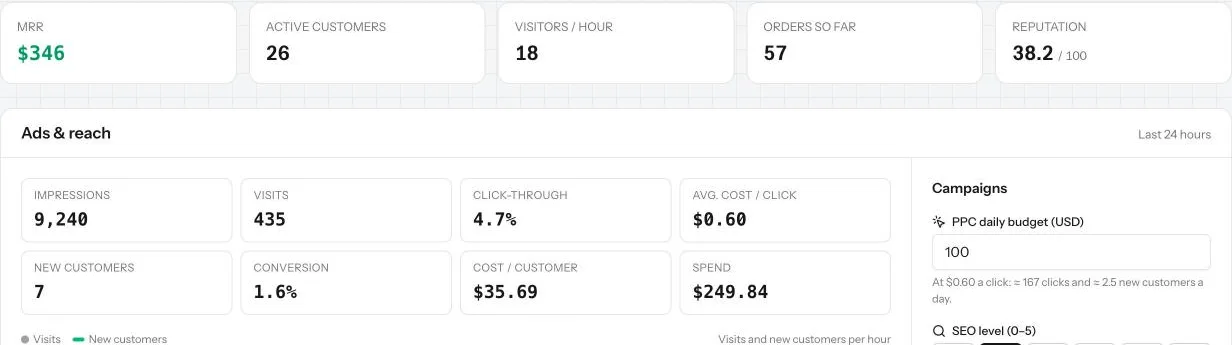
At the top you see the numbers that matter: MRR (how much your customers pay you per month in total), active customers, visitors per hour, orders so far and your reputation.
Groups: what you sell
A group is a product line. Each server goes into one group, and there are three kinds:
- Web hosting: many small websites share one server. Needs Linux. Each server also needs a control panel and antivirus license, paid monthly.
- VPS: the server is split into virtual servers, each rented by one customer. Needs the Hypervisor.
- Dedicated: one customer rents the whole machine. You set a monthly price per server.
To start one: choose the type, give it a name, click Create group, then pick a server and click Add server. VPS, hosting and dedicated compares the three.
Plans and stock
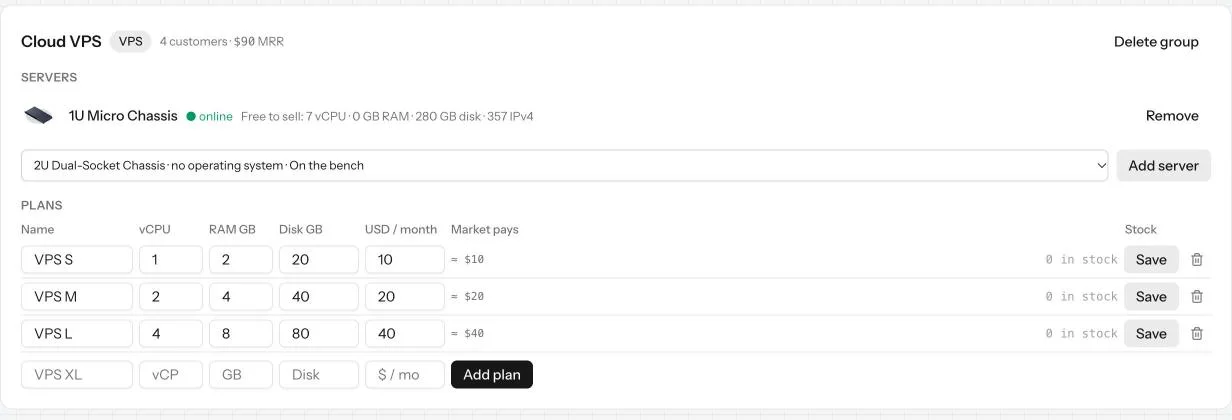
Hosting and VPS groups sell plans, like "VPS S" or "Business". A plan says how much of the server a customer gets (processor, memory, disk) and the monthly price. New groups come with starter plans; edit them, add your own or switch them off.
Stock is worked out for you from the hardware in the group: when the servers are full, a plan shows 0 in stock and nobody can buy it. Next to each server you see what is still free to sell. VPS and dedicated customers each also need their own IP address, so a cabinet that runs out of addresses stops selling them too (see Cabinets). A server that has run out of something turns amber on the Nodes page.
Prices
Customers know roughly what hosting is worth. The Market pays column shows the going rate for each plan.
- At or below that price, almost everyone who finds your plan buys it.
- Above it, more and more buyers walk away the higher you go.
- Above one and a half times the market price nobody buys, and customers already paying that much leave within the hour.
- Faster memory earns a little more: buyers accept a higher price on servers whose memory is faster than the base speed of its type (see Server parts).
- The Overview log tells you when people leave because of price, or because nothing was in stock.
Cheap is not always best: a low price fills a server quickly, but you need enough money for rent, power and licenses.
Bringing visitors in
Nobody finds a new hosting company on their own. Every visitor comes from marketing (more in Marketing):
- Ads (PPC): set a daily budget. Visitors arrive straight away and stop when the money does. Fast and easy to adjust.
- SEO: a monthly fee per level. Brings a steady stream of visitors while you pay.
- Blog posts: pay once, and every post permanently multiplies the visitors your ads and SEO bring. They add nothing without ads or SEO.
Visitors and orders arrive every five minutes, each slice with its share of the hour's ad and SEO spend. Only a small share of visitors place an order, so more visitors means more customers. You cannot set a budget your cash cannot carry: a day of ads and SEO must be covered by the cash in the bank.
Who buys what
Customers come in different kinds. Bloggers and small shops mostly want web hosting; software startups and game communities lean to VPS and dedicated; large companies prefer dedicated. Offering all three catches more of them.
Where your servers stand matters too: datacenters with high demand this week bring more orders.
Keeping customers
Customers stay while their service works (see Customers and churn). They leave when:
- their server is down (an outage, a dead part, a power cut),
- the cabinet's internet line is full and everything is slow,
- they are unhappy: slow disks, a crowded server or a price above the market wear them down,
- or simply over time.
The Customer voice feed on this page shows what customers say: complaints, praise, gossip and goodbyes. It is the earliest warning that something bothers them.
Every outage also lowers your reputation, and a good reputation turns more visitors into customers. A reliable company grows faster than a cheap one.
Common mistakes
- A group with no server in it, or a server that is offline: nothing is on sale.
- Plans bigger than any server can hold: they always show 0 in stock.
- Spending a lot on ads before there is stock to sell: visitors arrive, find nothing and leave.
- Prices far above the going rate: visitors come and nobody buys.
Want the numbers? The full rules: Selling hosting